
Truth in a post-Truth World
Free Access to Class Notes for TODAY Only - So you can appreciate the quality of each class! ENROL TODAY
“Jesus said to him, ‘I am the way, the truth, and the life.’” — John 14:6
1. The Problem with Truth
We live in a world where creating fakes & counterfeits has never been easier to do. Artificial intelligence can now generate books, music, photographs, and video indistinguishable from human creation. The line between real and manufactured has blurred to near invisibility. In this environment, the ancient question — What is truth? — is no longer merely philosophical. It is urgent.
Questions This Module Will Answer
• “Is Christianity just for people who can’t think for themselves?”
• “Can an intelligent person really believe in God?”
• “What is truth?”
• “Why does everyone just say ‘that’s your truth’?”
If you yourself had designed the criteria for accepting a truth claim — would those criteria, consistently applied, allow any truth at all?
1.1 Gen Z and the Truth Crisis
Various factors, including digital immersion, scepticism toward traditional institutions, and a strong emphasis on personal authenticity, shape this generation’s perception of truth. Understanding where they stand is not about critiquing a generation — it is about meeting people where they are.
Research Snapshot
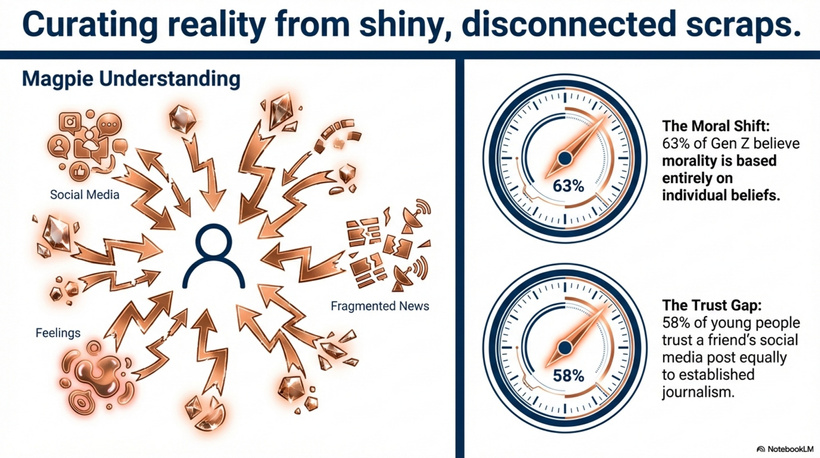
• 63% of Gen Z believe moral right or wrong depends on individual beliefs.
• 60% think moral standards change over time based on society.
• 58% consider social media posts from friends as more trustworthy as established journalism.
• 21% of surveyed Gen Z adults reported increased Bible reading in 2024.
Gen Z tends to trust peer networks and influencers more than traditional institutions. In contemporary culture, this dynamic is visible in diverse spheres—modern comedians who, through their platforms, become custodians of “truth” on social media, replacing academics and journalists (such as Joe Rogan, Russel Brand or Konstantin Kisin). Growing up in the digital age, they employ a “magpie” approach — curating their understanding of the world from diverse sources. While this allows for creativity and self-expression, it also raises questions about the coherence and reliability of their constructed truths.
Authenticity is paramount for Gen Z. The slang term “Keep it 100” encapsulates their desire for honesty and genuineness in all situations. This emphasis on being true to oneself underscores their broader approach to truth as deeply personal and expressive.
Despite a trend toward moral relativism, a notable segment of Gen Z is engaging with spiritual practices. This suggests a search for meaning and truth beyond secular frameworks, even as traditional religious institutions face scepticism.
1.2 What Is Truth? — Peter Kreeft’s Answer
One of the most luminous minds on this question is Dr Peter Kreeft, the 87-year-old Professor at Boston University, author of more than 70 books. He offers this deceptively simple but razor-sharp definition:
“Truth is what is. It is reality. It is what corresponds to the real world.” — Peter Kreeft, A Refutation of Moral Relativism
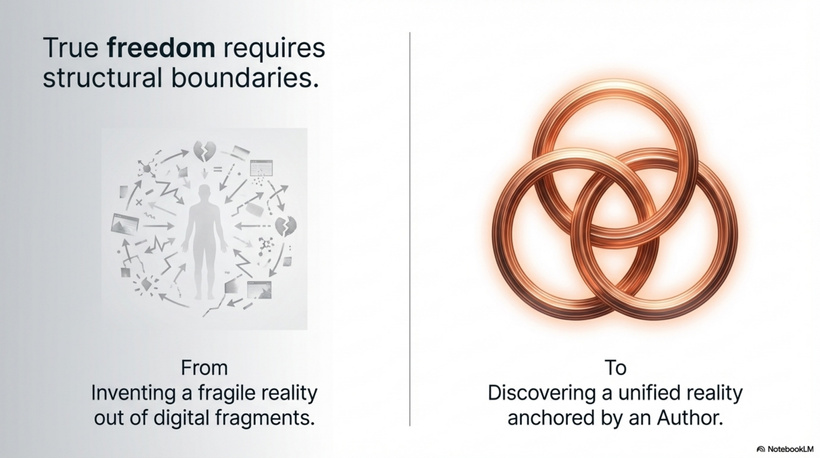
This reflects the classical correspondence theory of truth, rooted in Aristotle and Aquinas. Truth is not a matter of opinion, feeling, or consensus. It exists outside of us. It is not ‘my truth’ or ‘your truth’ — it is the truth.
“Truth is not invented; it is discovered. We do not make truth. We recognise it.” — Peter Kreeft
2. A Story for Those Who Still Seek
Let me tell you a story about a young boy named Theo. His name meant “God-seeker,” though he didn’t know it yet. He was a curious soul who asked the questions most grown-ups try to avoid.
Theo’s Questions:
• Why do people fight over what’s right?
• Why do rules change?
• Why do grown-ups lie?
• What is real? What is true?
He lived in a village between the Forest of Feeling and the Mountains of Opinion, where everyone seemed to have an answer — but no one seemed to agree. The village square had four loud voices on four corners, each passionately sure of their truth, but they contradicted each other.
So one morning, Theo tied his dusty shoes, packed a satchel with bread and a notebook, and stepped onto the winding road. “I’m going to find the Truth,” he said aloud to no one in particular, and the birds tilted their heads as if curious.
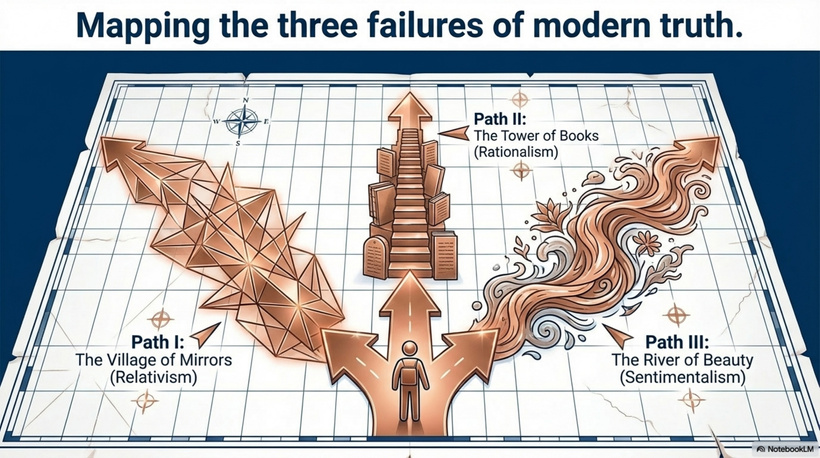
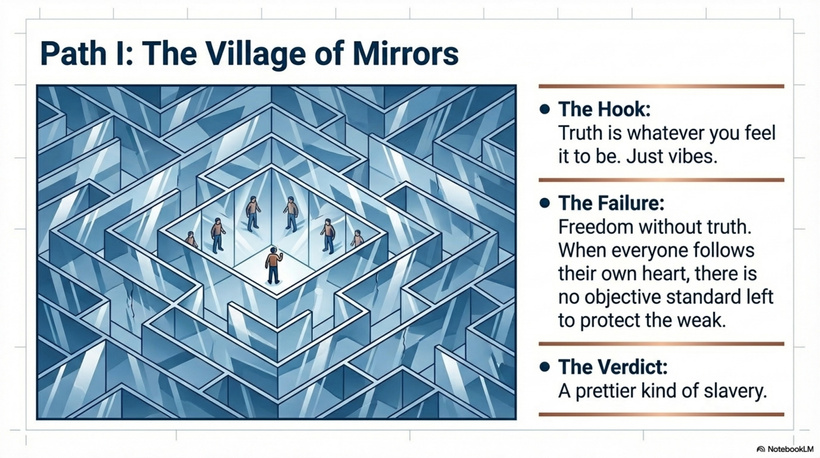
The Village of Mirrors
His first stop was the Village of Mirrors — a beautiful place, if you like glitter more than gold. Everything sparkled, reflections danced in every window, and everyone wore masks — not to hide, they said, but to “express themselves.”
The people greeted him warmly, assuring him that the truth is personal. “Truth,” they said with sweet smiles, “is whatever you feel it to be. Follow your heart. Create your truth.”
At first, Theo found it freeing. No rules, no guilt — just vibes. But then he noticed something strange: people hurting each other, cheating, slandering — and no one said anything. When he questioned it, someone shrugged, “That’s their truth.”
He looked into one of the many mirrors, and for a moment, he couldn’t even recognise himself. Something inside whispered:
“Freedom without truth is just a prettier kind of slavery.”
So Theo walked on, the echo of his footsteps the only real sound.
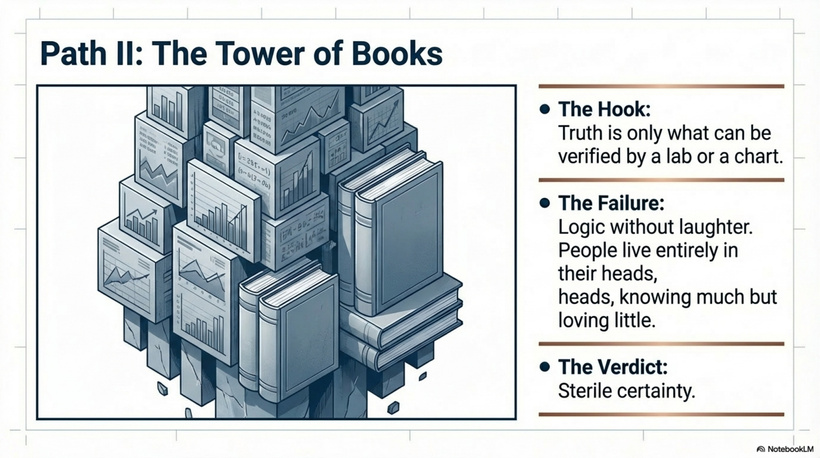
The Tower of Books
Eventually, he climbed a steep hill and came upon the Tower of Books. It pierced the clouds with shelves and staircases spiralling into the heavens. The air smelled of ink and candlewax. Here, scholars in robes debated constantly.
“Truth corresponds to reality,” one old man said, adjusting his round glasses. “We test it, verify it, line it up with reason.”
Theo appreciated their clarity — they had countless charts, infographics, thesis research, and meta-analyses stacked as high as he could see. But the higher he climbed, the colder it got. People lived in their heads. They knew much but loved little. Arguments never ended. It was logic without laughter.
And so, feeling wiser but not warmer, he descended and moved on.
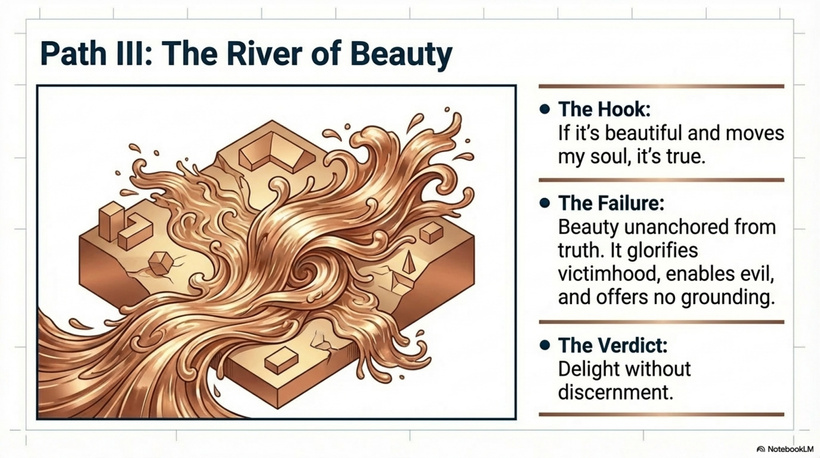
The River of Beauty
One afternoon, he stumbled into a valley where music floated on the wind and colours spilt over the hills. Here, they said, “Truth is what moves your soul. If it’s beautiful, it’s true.” Theo felt alive. He painted with children. He sang under the stars.
Until he saw a magnificent statue in the centre of the square. It glorified Victimhood and persecuted anyone who disagreed.
He asked, “How can something look beautiful and still be evil?” The smiles faded. “Don’t be judgmental,” someone said. But he couldn’t shake the unease. It was beauty unanchored. Delight without discernment. So he left the riverbanks, the melodies fading behind him like the end of a dream.
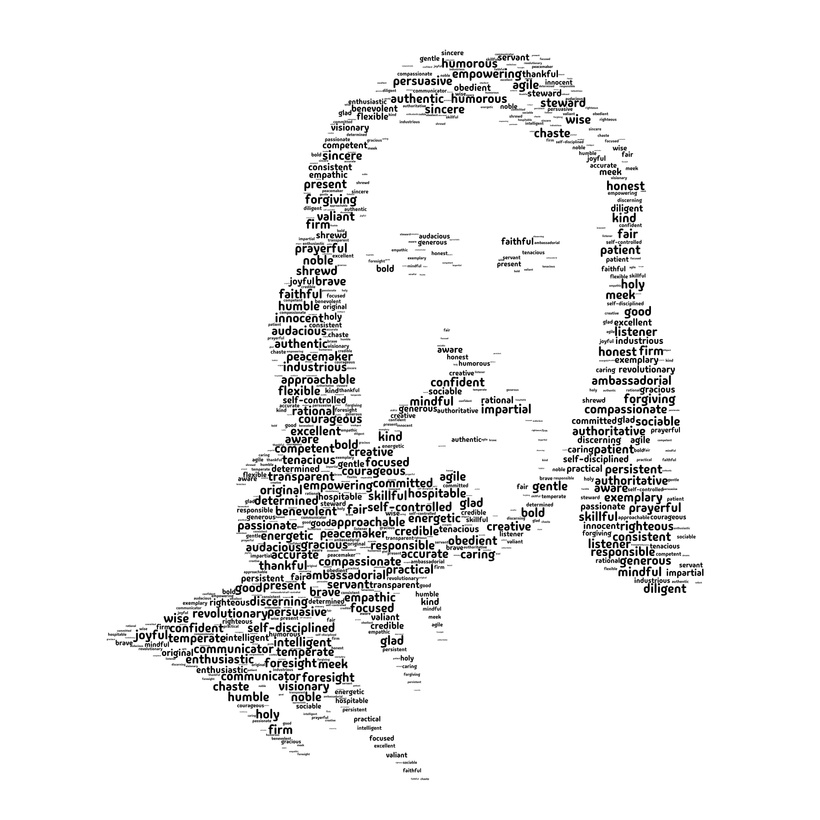
The Stranger at the Fire
As night fell, and he felt truly lost, he found a small fire burning in the wilderness. A Stranger sat beside it, wrapped in a cloak, his eyes reflecting the firelight — and something more profound, like oceans behind his gaze.
“Why are you searching for truth?” the Stranger asked.
Theo, too tired to pretend, answered honestly: “Because I’m tired of lies. Tired of confusion. I want something real. Something to build my life on.”
The Stranger tore a piece of bread and handed it to him. The warmth in his hands felt like something ancient. He leaned in and said gently:
“You seek a thing… but Truth is not a thing. Truth is a Person.” — The Stranger
Theo froze. “You mean… you?”
The Stranger nodded, his eyes smiling now.
“I am the Way, the Truth, and the Life.” — John 14:6
Something ignited in Theo’s heart. He had heard many explanations. But now, for the first time, he had met the Explanation Himself.
That night, the Stranger taught him by the fire. Not like a professor, but like a Father to a son. Theo realised something profound: he hadn’t just found the Truth. The Truth had found him.
When Theo finally returned home, he was different. He no longer needed to shout his questions into the air. He walked with the Answer.
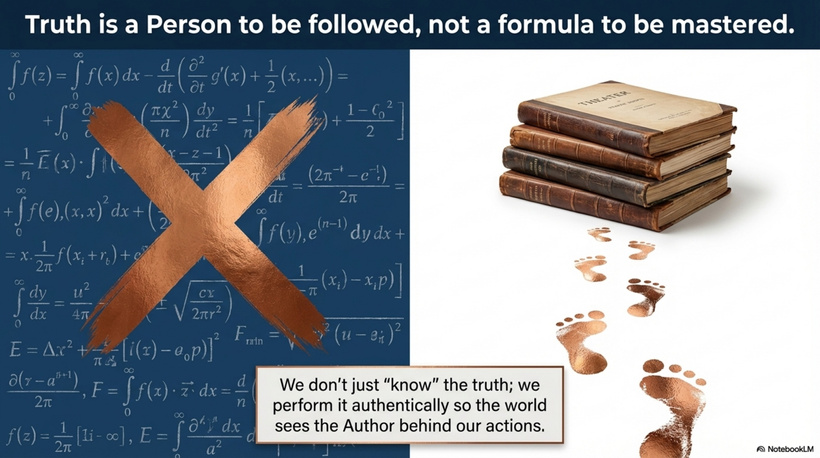
Truth is no longer a concept to be mastered. It is a Companion to be followed.
A Voice that leads. · A Presence that abides. · A Name: Jesus.
3. Truth as Drama
One of the most profound ways to understand truth is through the image of drama — not the shallow, soap-opera kind, but the rich, unfolding, purposeful drama that theologian Kevin J. Vanhoozer calls theodrama: the divine drama of God’s redemption story playing out in real time.
In this picture, Scripture is not just a textbook of information — it is a Script, a living Word that invites us to embody and perform the truth with our whole lives.
“I use the Bible as my divine script. I find the act and the scene, and then I play the script authentically.” — Dr. André Pelser
Each of us is an actor on God’s stage. Not performers putting on a show — but participants in a real story, called to interpret and live out the roles given to us by the divine Playwright. Every actor brings something of themselves into the role — emotion, personality, history, and voice. There’s room for unique interpretation, but never for rewriting the story.
But here’s the tragedy: many people today are trying to act out their lives without a script. They ad-lib through moral decisions, relationships, and purpose, reacting to others without a real sense of where they are in the plot. They don’t know who the main character is. They don’t know how the story began — and they certainly don’t know how it ends.
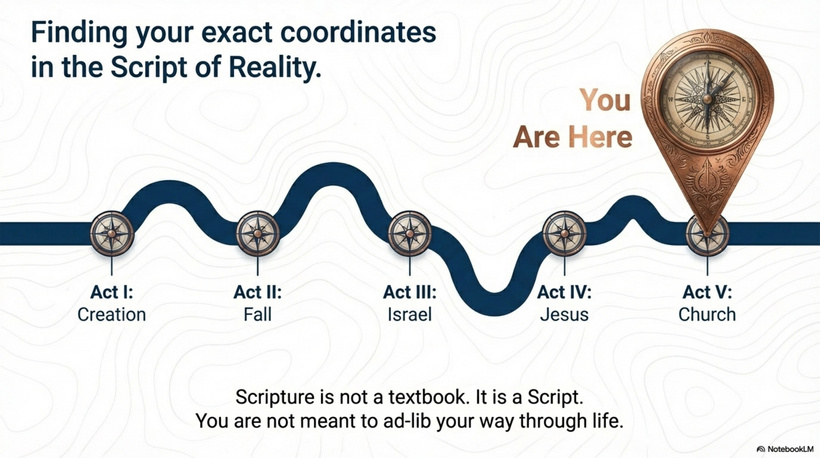
3.1 The Five-Act Structure of Scripture
According to Vanhoozer, the Bible unfolds like a five-act play. We don’t get to rewrite what came before us, and we don’t get to skip to the final curtain. Our task is to study the script, learn the story, know our lines, and perform our roles truthfully.
The Five Acts of the Divine Drama
1. Act I — Creation: The Author establishes the stage and its purpose.
2. Act II — Fall: The plot fractures. The human actors go off-script.
3. Act III — Israel: God begins the long work of restoration and revelation.
4. Act IV — Jesus Christ: The Author enters His own drama. The climax.
5. Act V — The Church: We are here. Act Five is not yet complete.
Truth, then, is not static. It’s dynamic. It is not just something you believe in your head, but something you live with your body. And the more faithful your performance, the more clearly the world sees the shape of the story — the Gospel — through you.
The question is not simply: “What do I believe?” The real question is: “How well am I playing the truth?”
“When we live the truth well, the audience doesn’t see us. They see the Author behind us.”
4. A Personal Word from the Author
Dr. Jan Oosthuizen writes:
“I will never forget the night I was baptized in the Holy Spirit in 1994. I got home late that evening, staying at our pastor’s home while my parents were away for a trip. They were good friends and I did not like the idea at all, but at the end it proved to my benefit. I was lying in bed, not having a Bible nearby — I remembered my New Testament lying in my bookcase. We had received it a few months earlier and I had not yet looked at it. I almost read through the whole of Matthew that evening; my spirit was hungry for more.
Since then the Bible became my companion — at times to prepare sermons, at other times to find direction — but then I discovered the Person of the Book. Looking into realities not seen with the physical eye, yet more real than any substance you can hold in your hand.
My prayer is that you would fall in love with the Word of God all over again, and that the tools introduced in the following chapters will help and guide you to be more effective.”
Smith Wigglesworth said:
“The Word of God — read it through, write it down, pray it in, work it out, pass it on.” — Smith Wigglesworth
This became the substance for this apostle of faith’s great work and ministry of healing, deliverance and salvation on Earth. The Bible is not an ordinary book with words in it. It is the words of God presented through man to man. Do not just study it to get sermons — study it so to know and understand Him better, see Him better, please Him more.
5. What is Biblical Interpretation?
The science of interpretation is generally known as hermeneutics — getting to know the heart and mind of the author — while the practical application of the principles of this science is exegesis.
What does Platon Antoniou (portrait photographer), Ilse Crawford (interior designer), and Cas Holman (toy designer) have in common? Their empathy for their clients. In order to discover more lucrative markets and drawing more customers, one needs to study, analyse, and find the heartthrob of what people desire at a given moment in time.
Empathy is also the key to calm adversarial conflict. When you can accurately verbalise the pain and discomfort of an angry person, you have won their heart — understanding quiets the storm.
The Motive Behind Accurate Bible Interpretation
To feel God’s heart, mind, and values. Ultimately we want to know Him!
Key NT texts on this goal:
• Rom 11:33 — the depth of the riches of the wisdom and knowledge of God
• Eph 4:13 — the full knowledge of the Son of God
• Col 1:10 — increasing in the knowledge of God
• 2 Pet 1:2 — grace and peace multiplied through knowledge of Him
5.1 The Source: Scripture, Spirit, and Assembly
Followers of Christ interpret life, time, and world events primarily from our knowledge of God as revealed through: (1) Scripture, (2) the Holy Spirit, and (3) the general assembly and church of the firstborn (Heb. 12:22–24).
2 Tim. 3:16–17 "All Scripture is given by inspiration of God, and profitable for doctrine, for reproof, for correction, for instruction in righteousness, that the man of God may be complete, thoroughly equipped for every good work."
5.2 Seven Principles of Interpretation
Dr. Oosthuizen outlines seven tested principles for accurately handling God’s Word:
1 — Slow Down and Pay Attention
Lessons from wine tasting are strangely instructive: slow down, pay attention, eliminate conflicting distractions, and build vocabulary. We all need to slow down before jumping to conclusions. Focus and eliminate distractions. Improve our vocabulary of discerning categories and the true meaning of words through study and experience (Heb. 5:13–14).
Most of our interpretive errors are not because we did not hear correctly — our interpretation was limited, and we jumped to misinformed conclusions. If Adam and Eve had gone back to God before making a decision, they would not have sinned. They chose knowledge above relationship.
2 — Interpret Scripture as Relational Communication
God’s Word is not a compilation of abstract literary words and sentences. The Bible is God’s way of communicating with us. Correct interpretation begins with becoming an exceptional listener.
The stories of Abraham, Moses, David, and Daniel — their triumphs and their mistakes — are like guiding lights in the darkness. The primary interpretive lesson: look at a life lived! Jesus is in this aspect our ultimate example. The Word became flesh and showed us the best way to do life.
“So opening the Bible can be likened to entering into a communicative event. Scripture begins a conversation that is interpersonal and potentially life-changing, because it is God who initiates the dialogue.” — Jeanine Brown, Scripture as Communication
3 — Investigation is Empathy
Journalists rigorously research source verification and fact-checking before they publish a story. Bible interpreters study the context, background, ancient narratives and audience, text category, language, culture, and intention of a portion of Scripture before making a current application.
Interpreting God’s Voice entails testing whether the word: is in line with the Spirit of Christ; is generally accepted among mature counsellors; convicts of sin, righteousness, and judgement; produces inner peace; is specific, practical, and conviction-based; ensures a generational blessing; is at the detriment to self; and is always missional.
4 — We Are More Wrong Than Right — Remain in Him
Job 36:4 "One who is perfect in knowledge is with you."
It is arrogant and conceited to think that one can understand God as one single individual. Searching God in isolation, as a resentment against man or the church, leads to great error. No single man can understand and embody the fulness of God. Jesus ascended and gave five gifts for the maturity of the saints, so that together we become collectively a perfect man, to the measure of the stature of the fullness of Christ (Eph. 4:13).
5 — Test the Fruit
Rigorously test the outcome of any interpretation. Bad fruit includes: cognitive dissonance, blaming, resentment, suspicion, anxiety, projecting guilt, shame, and cause-and-effect thinking without relational engagement.
Ask: Is the Lord going to be glorified? (1 Cor. 10:31). Is it going to build or break down? (1 Cor. 14:26). Is it doable? (James 1:22). Does it release faith or fear? Is it compatible with the fruit of the Holy Spirit?
6 — The Spirit of Christ Litmus Test
All Scripture points to Christ. All of creation points to Him too. The character, values, mindsets, ethics, habits, attitude and lifestyle of Christ is the benchmark for living. We are the most beautiful people when we are most like Christ.
Jesus does not preach a way to God — He preaches God’s way to us (John 3:16). He does not preach a set of rules and methods: He preaches a Person (John 6:28–29). Jesus makes us focus on God where religion makes us focus on self. He proclaims a truth that He Himself physically demonstrates to the letter (John 14:6).
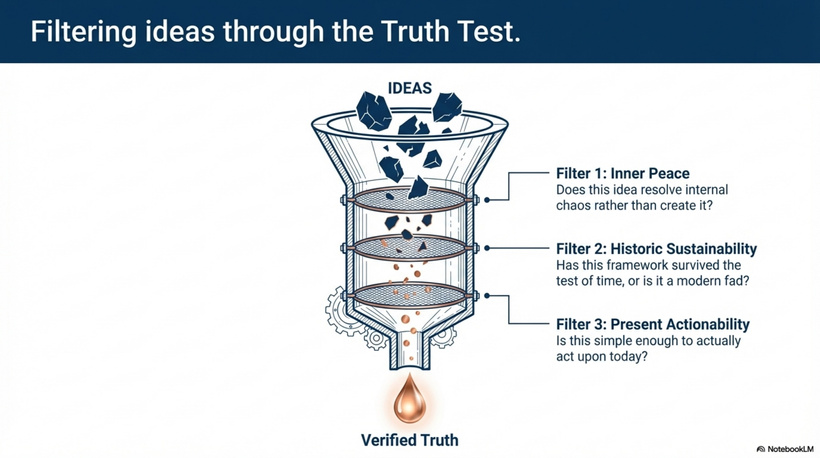
7 — The Truth Test
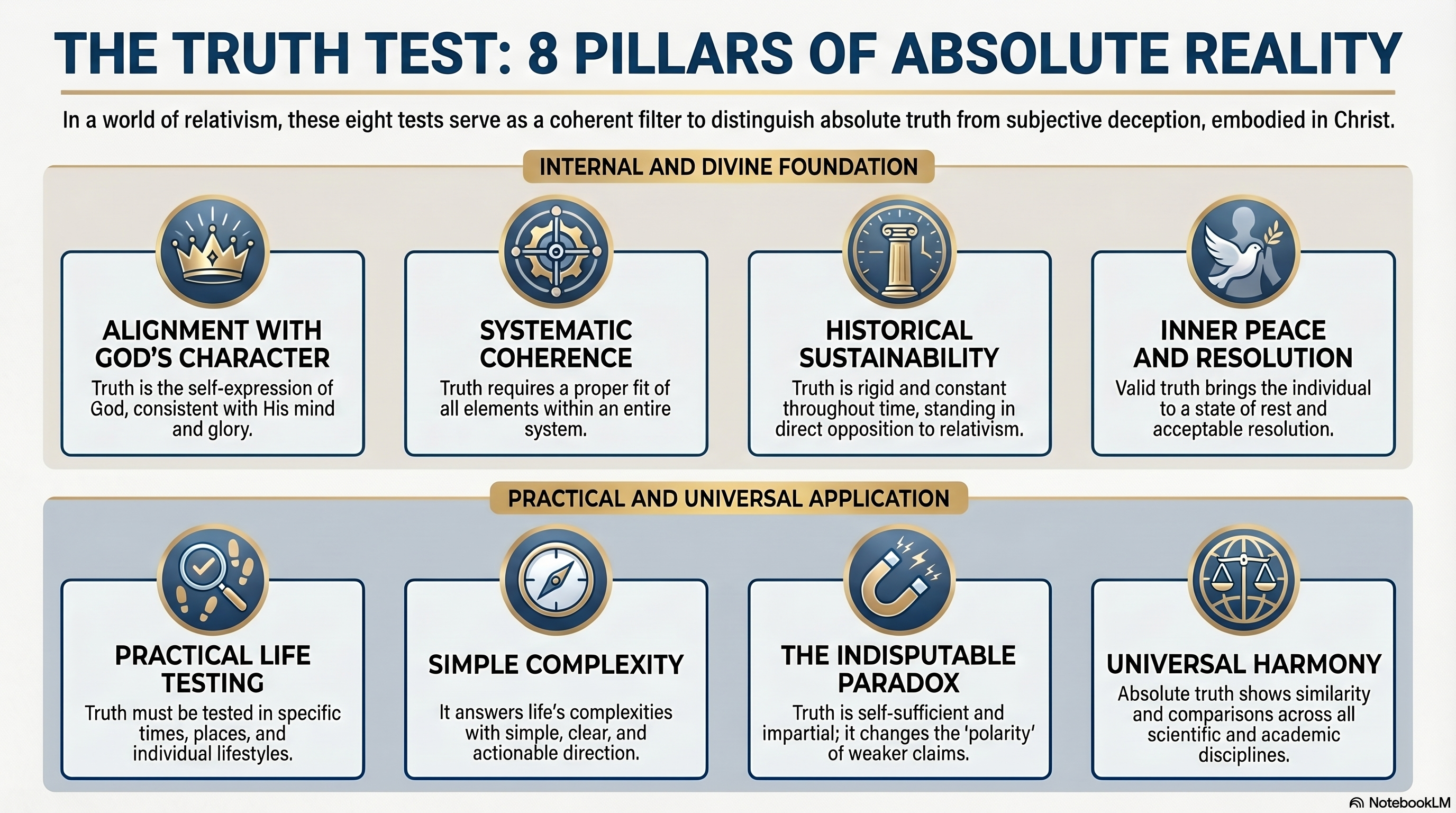
Apply these tests to any truth claim:
• Truth must bring the individual to inner peace, rest, and an acceptable resolution.
• Truth is consistent with the mind, will, character, glory, and being of God. Truth is the self-expression of God.
• Truth is coherent — it requires a proper fit of elements within an entire system.
• Truth is consistently sustainable and rigid throughout time and history — opposite to relativism.
• Truth must be tested practically in a particular life, place, time, and lifestyle.
• Truth must be both simple and complex — answering the complexity of life with good direction.
• Truth is a paradox: impartial, self-sufficient, indisputable. The strongest magnet changes the weaker magnet’s polarity.
• Truth should be universal — showing similarity and comparisons across all disciplines.
6. The Holy Ingredients of Truth
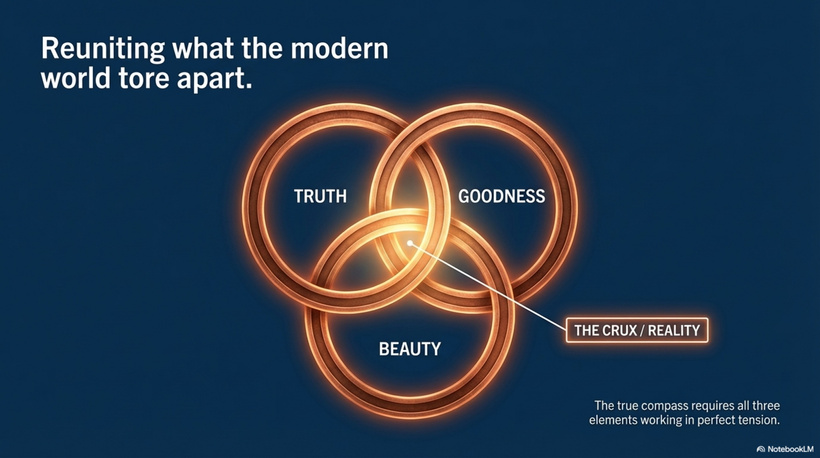
The fullness of truth integrates what philosophers call the Transcendentals — three properties that belong to all being: Truth, Goodness, and Beauty. Dr. Peter Kreeft puts it plainly:
“Truth is God known. Goodness is God obeyed. Beauty is God enjoyed.” — Peter Kreeft
6.1 Truth, Goodness, and Beauty
When separated, each becomes dangerous:
• Truth without goodness → cold legalism, harsh rationalism.
• Goodness without truth → sentimentalism, well-meaning but blind.
• Beauty without truth or goodness → idolatry, allure without moral grounding.
“Truth is beautiful when it leads to goodness; goodness is true when it flows from truth; and beauty draws the heart to both.”
In Christ, all three converge:
• Truth becomes revelation: “I am the way, the truth, and the life” (John 14:6).
• Goodness becomes incarnational: “He went about doing good” (Acts 10:38).
• Beauty becomes redemptive: “He had no beauty… yet we esteemed Him” (Isa. 53:2) — the paradoxical beauty of sacrificial love.
6.2 The Trinitarian Rhythm — Leonard Sweet
Leonard Sweet, the creative and prophetic Christian futurist, offers a rich re-framing of the Trinity not just as a doctrine to believe, but as a relational and missional rhythm to live by. He identifies three relational movements that mirror the persons of the Trinity:
The Three Movements of Trinitarian Life
Missional (Father) · Incarnational (Son) · Communional (Spirit)
• Missional — The Church is sent; never static. The Father is the sending God (John 20:21).
• Incarnational — The Church is embodied presence. Jesus pitched His tent among us (John 1:14). We don’t just preach the gospel — we live it.
• Communional — The Church is relational, intimate, and interwoven. The Spirit binds us to Christ and to one another (1 Cor. 12:13).
“We don’t go to church. We are the Church. And the Church is mission, incarnation, and communion.” — Leonard Sweet
Sweet challenges the mechanical, institutional church model and proposes a Trinitarian, organic, and relational ecclesiology. He believes the postmodern world needs not just right belief (orthodoxy), but also right relationship (orthopathy) and right practice (orthopraxy) — which again reflects the Trinitarian balance.
The Coin of the Church
One coin — three sides:
• The edge (Missional) — how we cut into the world.
• The face (Incarnational) — the image of Christ, visible to all.
• The back (Communional) — the unseen relational glue.
Lose one, and the coin is counterfeit.
7. Key Scripture References
The following scriptures form the backbone of this module. They are worth reading slowly, in their context, as relational communication from God to you.
On the Nature of Truth
John 14:6 "Jesus said to him, ‘I am the way, the truth, and the life. No one comes to the Father except through Me.’"
John 1:14 "And the Word became flesh and dwelt among us, and we beheld His glory… full of grace and truth."
John 8:32 "And you shall know the truth, and the truth shall make you free."
John 1:3–5 "All things were made through Him… In Him was life, and the life was the light of men."
On the Authority of Scripture
2 Tim. 3:16–17 "All Scripture is given by inspiration of God, and profitable for doctrine, for reproof, for correction, for instruction in righteousness."
Heb. 4:12 "For the word of God is living and powerful, and sharper than any two-edged sword."
Ps. 119:160 "The entirety of Your word is truth, and every one of Your righteous judgements endures forever."
On Coming to Know God
Rom. 11:33 "Oh, the depth of the riches both of the wisdom and knowledge of God!"
Eph. 4:13 "till we all come to the unity of the faith and of the knowledge of the Son of God."
Col. 1:10 "that you may walk worthy of the Lord… increasing in the knowledge of God."
2 Pet. 1:2 "Grace and peace be multiplied to you in the knowledge of God and of Jesus our Lord."
On the Trinitarian Mission
John 20:21 "As the Father has sent Me, I also send you."
John 17:21 "that they all may be one, as You, Father, are in Me, and I in You."
Acts 2:42–47 "And they continued steadfastly in the apostles’ doctrine and fellowship…"
Matt. 28:19 "Go therefore and make disciples of all the nations."
A Final Word
“Truth is not just a formula or a philosophy — it is a face.”
— Peter Kreeft
This module argued that we don’t merely need better information — we need a better relationship. The Bible’s approach to truth is not a system to be mastered, but a Person to be followed. In an age where AI can fake anything except authentic encounter with the living God, that distinction has never mattered more.
The curtain is rising. The world is watching. The Author is calling.
See Full Curriculum:

"Crux: Equipping the Gentle Warrior to answer the world's hardest questions with unwavering truth and unexpected grace."